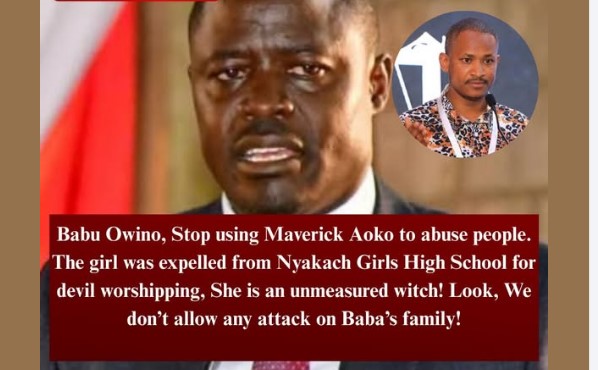
Nairobi politician Peter Kaluma has issued a stern warning to Babu Owino regarding his use of Maverick Aoko in public criticisms, describing the young woman as “an unmeasured witch” expelled from Nyakach Girls High School for alleged devil worship. Kaluma emphasized that personal attacks, especially those involving family members of prominent leaders like Raila Odinga, are unacceptable and should be avoided in political discourse.
At the heart of Kaluma’s statement is a call for restraint and ethical boundaries in politics. He criticized the exploitation of Maverick Aoko, arguing that using her as a tool for political attacks not only endangers her reputation but also crosses moral and legal lines. By highlighting her past expulsion from school for alleged misconduct, Kaluma aimed to question her credibility while also signaling that she should not be weaponized against anyone, particularly high-profile figures.
Supporters of Kaluma’s intervention see it as an attempt to uphold decorum and protect individuals from being unfairly targeted for political gain. They argue that Kenyan politics has increasingly normalized personal attacks and that such behavior undermines public trust and decorum. Kaluma’s statement reinforces the principle that criticism should remain issue-based and not devolve into personal vendettas.
Critics, however, might view his remarks as politicized, framing personal attacks within the lens of loyalty to Baba (Raila Odinga). Some may argue that calling Maverick Aoko a “witch” perpetuates harmful stigma and distracts from the broader conversation, turning personal histories into ammunition rather than focusing on substantive policy or leadership issues.
The controversy also reflects a broader tension in Kenya’s political culture, where social media personalities and influencers are increasingly drawn into political battles. Their involvement can amplify messages, but also exposes them to manipulation, reputational harm, and public scrutiny that may be disproportionate to their influence.
Ultimately, Peter Kaluma’s warning highlights the need for responsible political engagement. While criticism and debate are essential in a democratic society, there are boundaries that protect individuals—especially young and vulnerable figures—from being exploited or maligned for partisan purposes. The episode serves as a reminder that ethical conduct and respect for personal dignity remain critical, even in highly charged political environments.