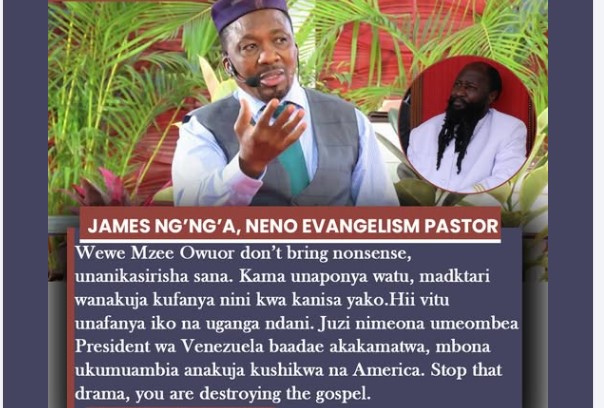
Controversial televangelist Pastor James Ng’ang’a has once again ignited public debate after delivering a fiery lecture directed at Prophet David Owuor, accusing him of misleading believers and damaging the integrity of the Christian gospel. Ng’ang’a’s remarks, delivered in his trademark blunt and confrontational style, have drawn mixed reactions from Kenyans, reopening long-standing discussions about prophecy, healing, and accountability within modern Christianity.
At the heart of Ng’ang’a’s criticism is Owuor’s widely publicized claims of divine healing. Ng’ang’a questioned the logic behind churches hosting doctors and medical personnel if, as claimed, miraculous healings are taking place. To him, this contradiction raises serious concerns about honesty and transparency in the pulpit. He went further to suggest that some of the practices associated with Owuor’s ministry resemble uganga (traditional spiritual practices), a claim that sharply challenges the theological legitimacy of such healings within Christian doctrine.
Ng’ang’a also referenced an incident involving Owuor’s prayer for the President of Venezuela. According to Ng’ang’a, Owuor publicly prayed for the leader shortly before international developments led to the president’s arrest or detention. This, Ng’ang’a argued, exposed the weaknesses in Owuor’s prophetic credibility, questioning why a self-proclaimed prophet did not foresee or warn about the impending outcome. For Ng’ang’a, prophecy without accuracy becomes performance rather than divine revelation.
Beyond specific incidents, Ng’ang’a’s broader concern was what he described as “drama” in the church. He warned that exaggerated prophecies, sensational miracles, and fear-driven preaching risk destroying the true message of the gospel. In his view, Christianity should be grounded in truth, humility, and responsibility, not spectacle designed to attract crowds and command blind loyalty from followers.
Supporters of Prophet Owuor have dismissed Ng’ang’a’s remarks as disrespectful and dismissive, arguing that spiritual matters cannot always be measured through human logic. They maintain that prophecy and healing are matters of faith, not science, and accuse Ng’ang’a of attacking a fellow preacher rather than addressing issues privately. Critics of Owuor, however, see Ng’ang’a’s outburst as a rare moment of honesty within a religious space that often avoids self-critique.
Ultimately, the exchange highlights a deeper crisis facing contemporary Christianity: the tension between faith and accountability. As churches grow more influential and prophets gain massive followings, questions about truth, responsibility, and ethical leadership become unavoidable. Whether one agrees with Pastor Ng’ang’a’s tone or not, his remarks have forced believers and observers alike to reflect on where genuine faith ends and religious theatrics begin.
In a society where the pulpit holds immense power, such debates may be uncomfortable—but they are necessary if the gospel is to remain a source of hope rather than confusion.